


The Spies Among Us: What Parashat Sh'lach Teaches About Jews Who Reject Israel

Each week, I read the parashah (a weekly Torah portion) and try to learn from our past, from our book, and from the long journey of the Jewish people. The Torah is not only history. It is a warning, a mirror, and sometimes an uncomfortable reminder that the challenges we face today are not new.
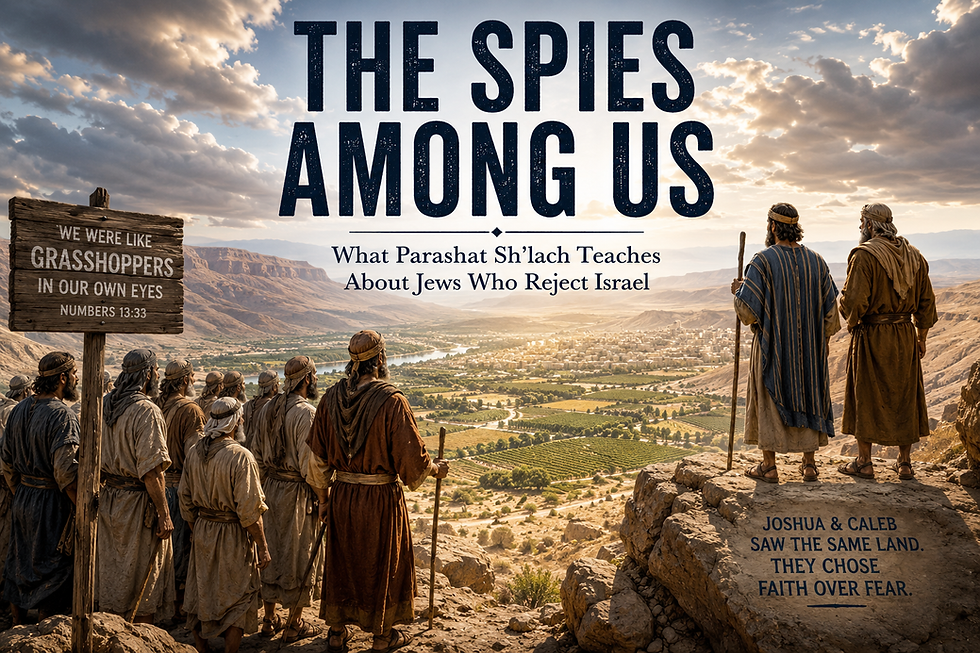
This week, in Parashat Sh'lach, Moses sends twelve spies to scout the Land of Israel. They all see the same land. They all know it is the future of the Jewish people. But ten of them return with fear; they tell the people that the land is too dangerous, the enemies too strong, the mission too heavy. Their most painful words are not about the enemies. They are about themselves: “We were like grasshoppers in our own eyes.”
One of the most fascinating aspects of this story is what we might call the psychology of "grasshopper mentality." The spies were not defeated by the inhabitants of the land; they were defeated by their own perception of themselves. Before anyone attacked them, they had already convinced themselves that they were small, powerless, and destined to fail.
This is one of the most destructive patterns individuals and nations can develop. When people begin to see themselves through the eyes of their critics, they gradually lose confidence in their own legitimacy. They start questioning their right to exist, their right to succeed, and even their right to defend themselves. Over time, this mindset becomes a form of self-destruction.
The Jewish people have faced this challenge throughout history. External enemies can inflict damage, but internalized doubt can be even more dangerous. The moment we accept the negative image others project onto us, we begin surrendering long before any real battle has begun.
Joshua and Caleb saw the same reality, but they refused to surrender the Jewish future to fear. They understood that the land would not be easy, but it was still ours. They understood that difficulty does not erase destiny.
I do not usually write about the parashah every week. I read it each week, but most weeks I simply reflect on its lessons and move on. This week, however, this story struck me in a particular way. It reminded me of patterns I have seen before, both in our history and in our present, and that is why I felt compelled to write about it.
There have always been Jews who, under pressure from the outside world, begin to see themselves through the eyes of those who reject them. Today, we see this in some Jewish voices that reject Zionism; they reject the idea that the Jewish people have the right to self-determination in their ancestral homeland.
Criticizing the Israeli government is legitimate. Israelis do it every day. Rejecting the very idea of Jewish self-determination is something entirely different. It reflects the same loss of confidence that we see in the spies. A willingness to accept that Jewish nationhood is uniquely problematic, that Jewish sovereignty is somehow illegitimate, and that the Jewish people alone should live without the protections and rights afforded to other nations.
The parashah teaches that faith is not the absence of challenges. It is the ability to face them without losing confidence in who we are and where we are going. The punishment that followed the ten spies’ rejection of the promise, barring the entire adult generation of Israelites over the age of 20 from entering the Promised Land, can be understood not only as a consequence of fear, but also as a symbol of what happens when a people lose faith in their mission. A generation that could not believe in its own future was unable to enter it.
For nearly 2,000 years, Jews prayed for Jerusalem. We carried Zion in our memory, in our rituals, in our language, and in our tears. The State of Israel is not a political inconvenience; It is the return of a people to its story.
Parashat Sh'lach reminds us that the danger is not only the enemy outside the camp. Sometimes the greater danger is the voice inside the camp that says we are too small, too guilty, too weak, or too ashamed to stand for ourselves.
The spies saw giants and became grasshoppers in their own eyes. Joshua and Caleb saw the same giants and still believed in the Jewish people.
That choice remains ours today.

Comments